
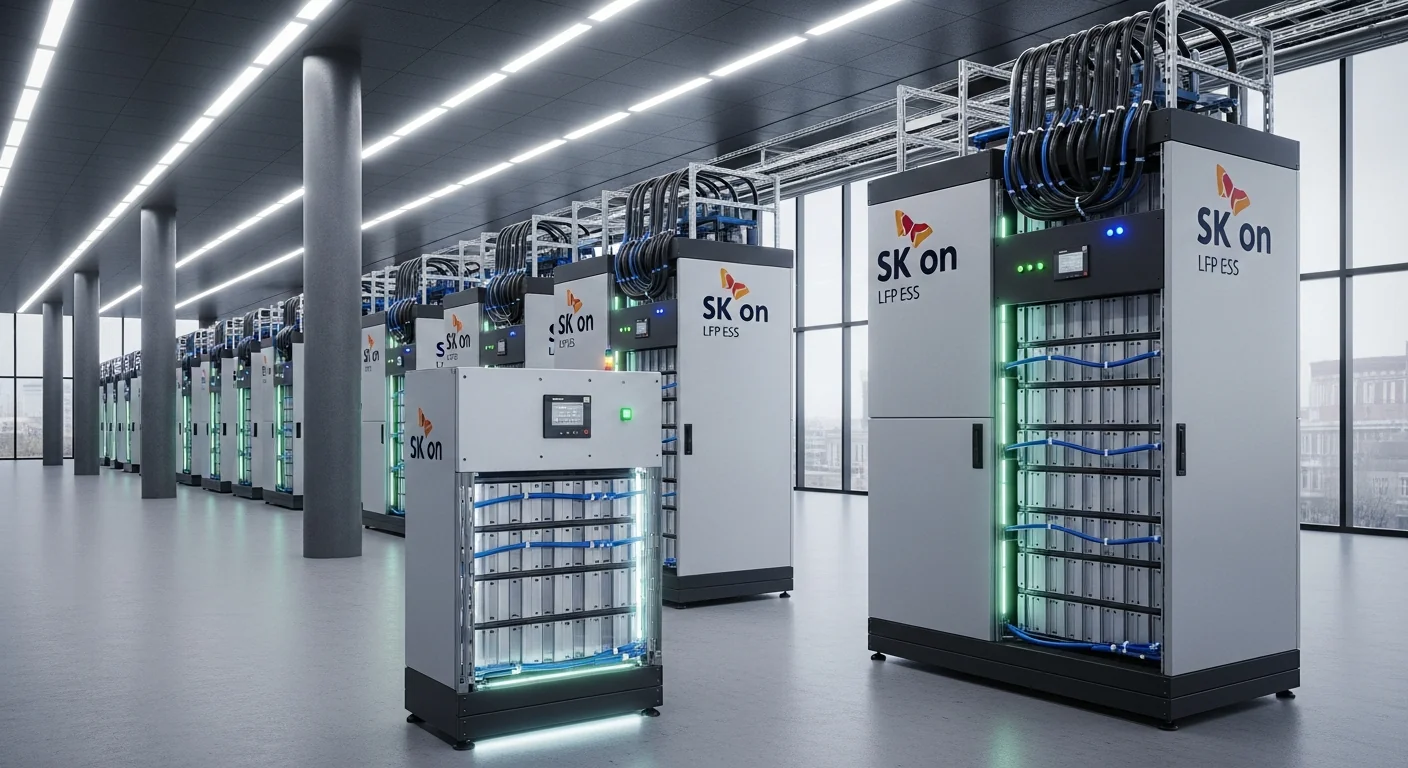

SK On Dominates ESS Market, Securing Over 50% Share
In a decisive move, SK On has seized more than half of the KRW 1 trillion second-round ESS central contract market. The key to this victory is a powerful strategic advantage: domestically produced LFP batteries using local materials. This local-first approach is particularly resonant in a market where a staggering 80% of past ESS fires have been linked to overseas batteries.
The Technology Behind SK On’s LFP Edge
SK On’s LFP batteries are built on a foundation of lithium, iron, and phosphate—a chemistry prized for its exceptional thermal stability and long lifespan. Layered on top is a proprietary Battery Management System (BMS) that actively prevents overcharging, over-discharging, and overheating by monitoring voltage, current, and temperature in real time. The final piece of the puzzle is the company’s ability to tailor configurations for any ESS site, guaranteeing peak operational performance.
Market Impact Analysis
- Accelerated Growth of the Korean ESS Market: SK On’s win will supercharge the domestic ESS market. After being valued at roughly KRW 5 trillion in 2023, the market is now forecast to blow past KRW 7 trillion in 2024, according to SNE Research.
- Increased Localization Rate of Battery Materials: The company’s commitment to domestic materials isn’t just a safety play; it directly strengthens Korea’s battery supply chain and reduces import dependency. This strategic sourcing is expected to push the material localization rate from its current 60% to over 70%.
- Expanded Market Share of LFP Batteries: This major win for SK On’s LFP technology marks a clear market pivot away from NCM chemistries. LFP batteries are gaining unstoppable momentum in both ESS and electric vehicles, thanks to their lower cost and superior safety. According to BloombergNEF, their market share is projected to jump from 30% in 2023 to over 40% in 2024.
Competitive Landscape
SK On is carving out a decisive lead by focusing on a winning formula that rivals are overlooking. While LG Energy Solution targets niche ESS applications with high-performance NCM batteries and Samsung SDI emphasizes advanced safety features, SK On is capitalizing on the dual strengths of LFP technology: lower costs and proven reliability. Swift quality control, a direct benefit of local production, only amplifies this advantage.
3 Steps You Should Take Now
- Evaluate ESS Adoption: For any business serious about cutting energy costs and ensuring power stability, now is the time to evaluate adopting an ESS.
- Engage with Market Leaders: The logical next step for serious buyers is to engage directly with SK On for a customized ESS consultation.
- Leverage Government Incentives: To overcome the initial investment hurdle, companies must actively pursue available government support policies for ESS installation.
One-Year Outlook
SK On’s roadmap for the next 12 months is nothing short of aggressive. The company plans to boost the energy density of its LFP ESS products by more than 15% and integrate them with a next-generation BMS for even greater safety. At the same time, it is making a major push into North America, targeting 10 GWh in new contracts fueled by the booming data center and renewable energy markets.
