
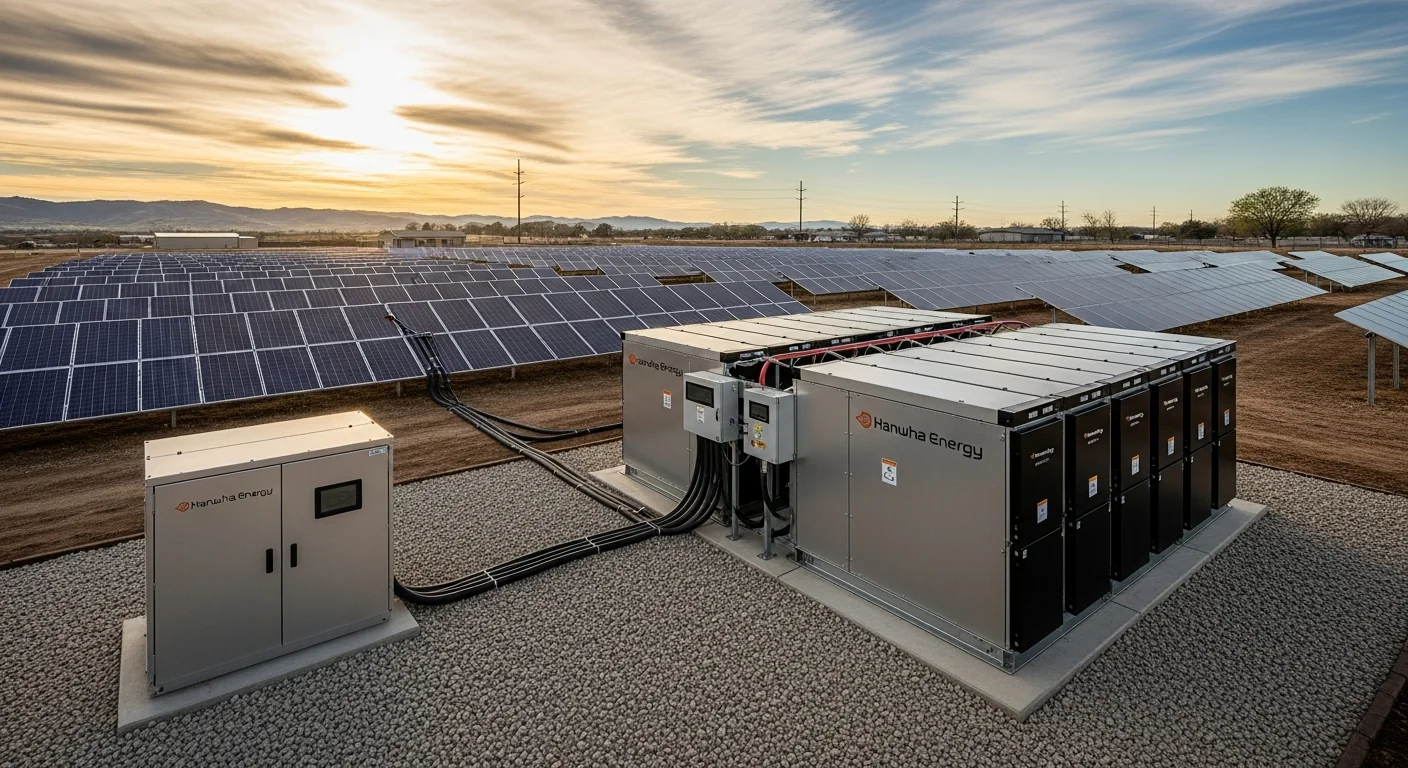

Hanwha’s $31B War Chest Targets US Renewables Dominance
Hanwha Energy is making a bold play for the American renewables market. Partnering with a $31 billion global infrastructure investor, the company is set to aggressively expand its footprint in renewables and Battery Energy Storage Systems (BESS). This strategic alliance injects a massive capital infusion into a market that surged 20% last year, effectively firing the starting gun on a major battle for market share.
Analysis: A Three-Pronged Strategy of Tech, Market, and Competition
Technical Aspects: Central to Hanwha’s strategy is an integrated portfolio of solar, wind, and, most critically, its advanced BESS technology. This new funding is more than a simple expansion play; it’s a direct investment aimed at refining these capabilities and accelerating innovation. The company’s lithium-ion BESS stands out as the key differentiator, offering the grid stabilization and peak demand management needed to solve the intermittency problem inherent in other renewables.
Market Impact:
- Market Share Expansion: An ambitious goal has been set: to more than triple its US market share from 3% to over 10% within five years. This won’t be achieved through organic growth alone. Expect a flurry of aggressive acquisitions and strategic partnerships.
- Job Creation: This expansion directly translates into American jobs, with projections pointing to over 5,000 new positions in the renewables sector. The move is a savvy alignment with federal green energy initiatives and a boon for regional economic development.
- Energy Price Stabilization: A massive build-out of BESS capacity promises a more resilient national grid. By smoothing out peak demand and curbing price volatility, this infrastructure push is poised to drive down US energy costs by as much as 10% over the next five years.
Competitive Landscape:
- NextEra Energy: While NextEra Energy remains the dominant force in US wind and solar, Hanwha’s laser focus on superior BESS technology hands it a crucial advantage in the vital energy storage segment.
- Vestas: Danish wind turbine giant Vestas represents both a competitive threat and a potential partner. A strategic alliance could become a shortcut for Hanwha to rapidly scale its wind operations and cement its US market presence.
Market Context in Numbers:
- The sheer scale of the opportunity is confirmed by the US Energy Information Administration (EIA), which reported that renewables accounted for 23% of the nation’s electricity generation in 2023.
- Underscoring the focus on storage, BloombergNEF (BNEF) projects the global market will explode to $1.2 trillion by 2030.
- The long-term imperative is stark: according to the International Energy Agency (IEA), hitting 2050 carbon neutrality goals demands that renewables account for over 90% of all energy generation.
Strategic Takeaways for Industry Watchers
- Portfolio Reassessment: Investors must re-evaluate their exposure to the renewables sector. Hanwha’s aggressive play instantly makes the company, and the BESS sub-sector in particular, a compelling area for new capital.
- Focus on Supply Chain and Efficiency: This influx of capital and projects will inevitably strain supply chains. Everyone in the ecosystem, from raw material suppliers to logistics firms, must brace for a surge in demand and sharpen their operational efficiency to capitalize on the boom.
- Track Regulatory Tailwinds: Federal and state green energy policies are the critical catalyst here. Closely tracking shifts in subsidies, tax credits, and permitting regulations will be essential for anyone looking to anticipate market movements and seize new opportunities.
Outlook: The Next 12 Months
Over the next 12 months, expect Hanwha Energy to break ground on several major US projects, likely pushing its market share past the 5% mark ahead of schedule. But the real story to watch is its bid for BESS dominance. A significant slice of this new capital is earmarked specifically for deploying next-generation storage technology at an unprecedented scale.
