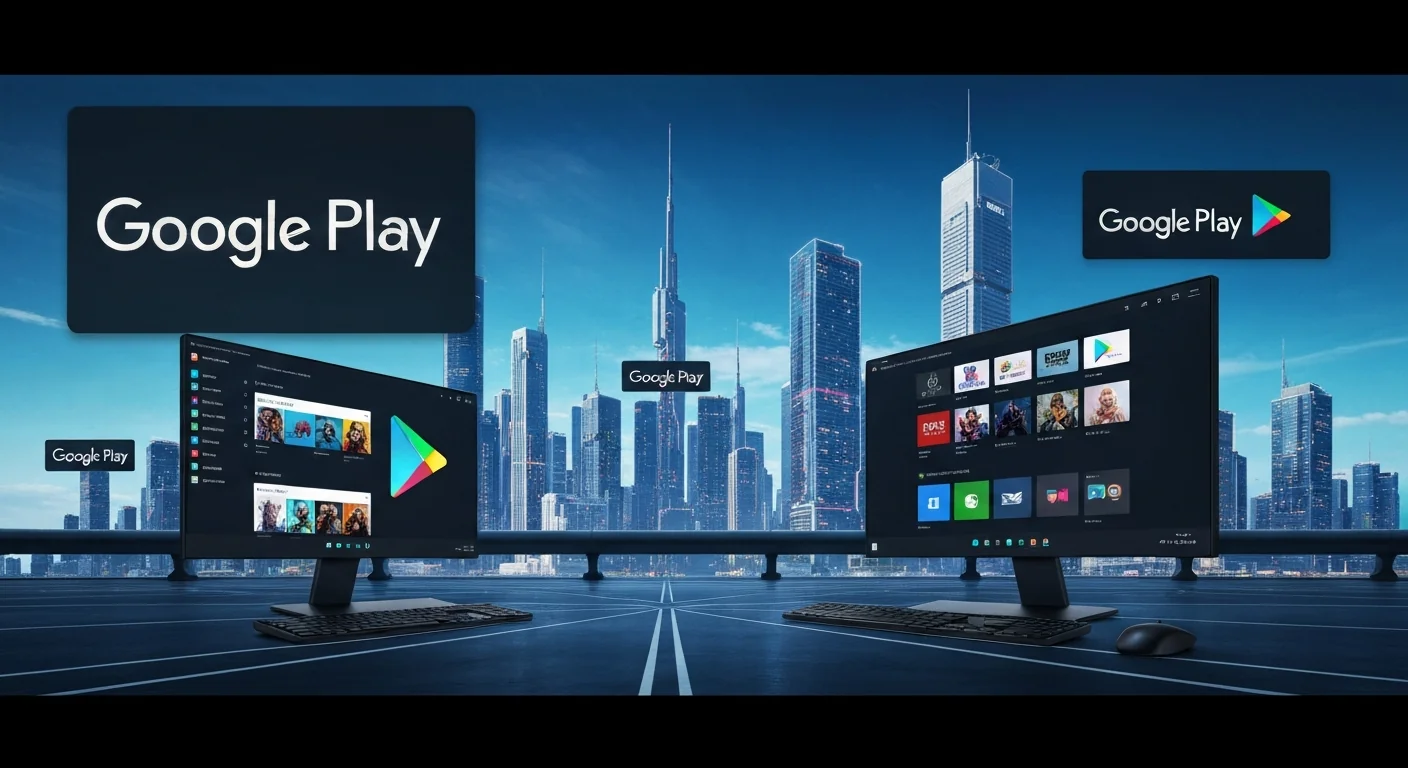

Google Play Games’ PC Expansion Accelerates Ecosystem Unification
With the mobile gaming market projected to hit $103 billion by 2025—a staggering 55% of the entire industry—Google’s expansion of Play Games to the PC is far more than simple diversification. This is a strategic power play designed to consolidate the company’s dominance in the global gaming landscape.
The official beta for Google Play Games on PC began its rollout in January 2022, initially launching in key Asian markets like Korea, Hong Kong, and Taiwan before expanding to over 140 countries by 2023. What started as a way to emulate Android titles has evolved into a full-fledged standalone application for Windows 10 and 11. Its core strength lies in seamless cross-device continuity, allowing players’ game progress and purchases to sync effortlessly between their phones and PCs.
Strategic Insight and a Reshaped Competitive Landscape
Google’s push into the PC market serves as a crucial defensive strategy. As popular mobile-native games release dedicated PC versions on Steam or the Epic Games Store, Google risks losing players—and their revenue—to these established platforms. Google Play Games on PC is designed to plug this leak, keeping users and their spending firmly within its own ecosystem.
Beyond defense, Google is mounting a direct offensive by championing native PC games, not just emulated mobile titles. The company now offers a dedicated PC SDK, complete with tools for in-app purchase integration and robust security. Developers can now manage both mobile and PC builds from a single Google Play Console. Critically, the introduction of a ‘buy once, play anywhere’ model for certain games positions Google Play Games as a direct challenger to PC gaming’s old guard.
The PC gaming market itself is a lucrative prize, valued at an estimated $61.84 billion in 2024 and forecast to explode to $129.93 billion by 2030, marking a 13.5% compound annual growth rate from 2025. To capture a piece of this pie, Google is leveraging its colossal Play ecosystem of over 2 billion monthly active users. Financial incentives, like an ‘earnback program’ that offers up to 15% in additional revenue and new advertising tools, are being deployed to aggressively court developers.
To retain these new users, the player experience is also getting a significant upgrade. Google has steadily rolled out PC-native features, including full keyboard and mouse support, 4K resolution capabilities, custom control remapping, and even multi-instance support. An upcoming ‘Game Trials’ feature for select paid games will further lower the barrier to entry for new players.
Actionable Conclusion for Investors
Google’s expansion into PC gaming is a clear bet on a unified, cross-platform future. The success of this venture will be determined by developer adoption. Investors must track key metrics: the uptake rate of the native PC SDK, the efficiency of the integrated build management tools, and how appealing the revenue-sharing models prove to be for both mobile and PC-first studios.
The primary obstacle remains the formidable dominance of incumbents like Steam, which boast massive user bases and mature community features cultivated over decades. To compete, Google Play Games must deliver undeniable value by weaponizing its unique advantage: the seamless bridge from mobile to PC. The market’s future will be shaped by how effectively Google can stimulate cross-platform development and whether the ‘buy once, play anywhere’ model gains widespread traction. These factors will ultimately dictate the growth of Google’s future advertising revenue and platform fees.
References & Sources
- >coopboardgames.com — coopboardgames.com
>wikipedia.org — wikipedia.org
참고문헌
