
SK On’s Secret to Dominating 50% of the ESS Market
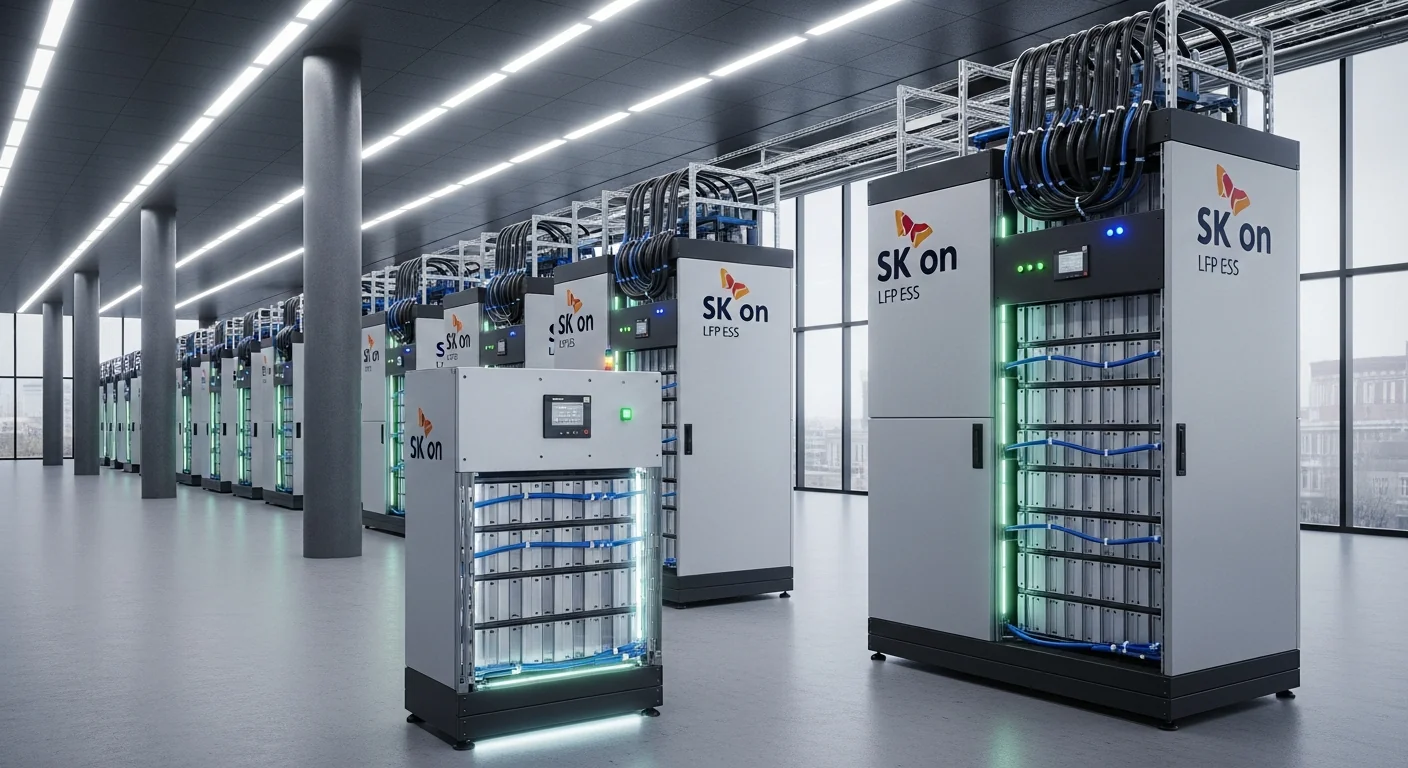
A telling statistic reveals that 80% of domestic ESS fires originate from foreign-made batteries. This is precisely the vulnerability SK On has exploited. In the 1 trillion KRW secondary ESS central contract market, SK On has secured a commanding 50% market share, a success built on the safety and reliability of its LFP batteries, which are produced in Korea using domestic materials.
A Deep Dive into SK On’s ESS Technology
At the heart of SK On’s technology is its LFP battery, a combination of lithium, iron, and phosphate engineered for maximum thermal stability and a long lifespan. This is augmented by a proprietary Battery Management System (BMS) that actively monitors voltage, current, and temperature in real-time to preemptively block potential hazards like overcharging, over-discharging, and overheating. Another key competitive advantage is the company’s ability to customize battery capacity and system configurations, optimizing them for diverse installation environments and operational demands.
Analyzing the Impact on the ESS Market
- Accelerating Domestic ESS Growth: SK On’s massive order win is set to act as a catalyst, accelerating the explosive growth of the domestic ESS market. SNE Research forecasts the market will surge from approximately 5 trillion KRW in 2023 to over 7 trillion KRW in 2024.
- Increasing Localization of Battery Materials: This move signals a green light for the localization of battery materials. As SK On increases its adoption of domestic components, it will inevitably bolster the competitiveness of the entire local materials ecosystem. The prevailing view is that the localization rate, currently at 60%, will surpass 70% under SK On’s leadership.
- Expanding LFP Battery Market Share: LFP technology is fundamentally reshaping a market once dominated by NCM (nickel-cobalt-manganese) batteries. Armed with price competitiveness and superior safety, demand for LFP batteries is exploding not only in ESS but also in the electric vehicle sector. BloombergNEF projects LFP’s market share will jump from 30% in 2023 to over 40% in 2024.
Competitive Landscape Analysis
SK On’s strategy presents a stark contrast to its rivals. While LG Energy Solution focuses on high-performance NCM-based ESS and Samsung SDI concentrates on developing proprietary safety features, SK On has opted for a rapid market seizure strategy, leveraging the price competitiveness and safety of LFP. Its domestic production base, which enables stringent quality control and swift customer response, has created a competitive gap that rivals will find difficult to close.
Three Immediate Actions to Consider
- Evaluate ESS Adoption: If cutting energy costs and securing a stable power grid is a priority, now is the time to evaluate an ESS.
- Consult with SK On: Explore a tailored consultation with SK On, whose ESS solutions offer proven safety and supply chain stability.
- Leverage Government Incentives: Thoroughly review and utilize government support policies for ESS installation to significantly reduce the initial investment burden.
Outlook for the Year Ahead
Over the next year, SK On’s technological advancement will not slow down. The company plans to boost the energy density of its ESS-specific LFP batteries by over 15% and integrate a more sophisticated, next-generation BMS to elevate safety standards even further. These enhancements will serve as a launchpad for an accelerated push into the North American market, solidifying its position as a global ESS powerhouse.
