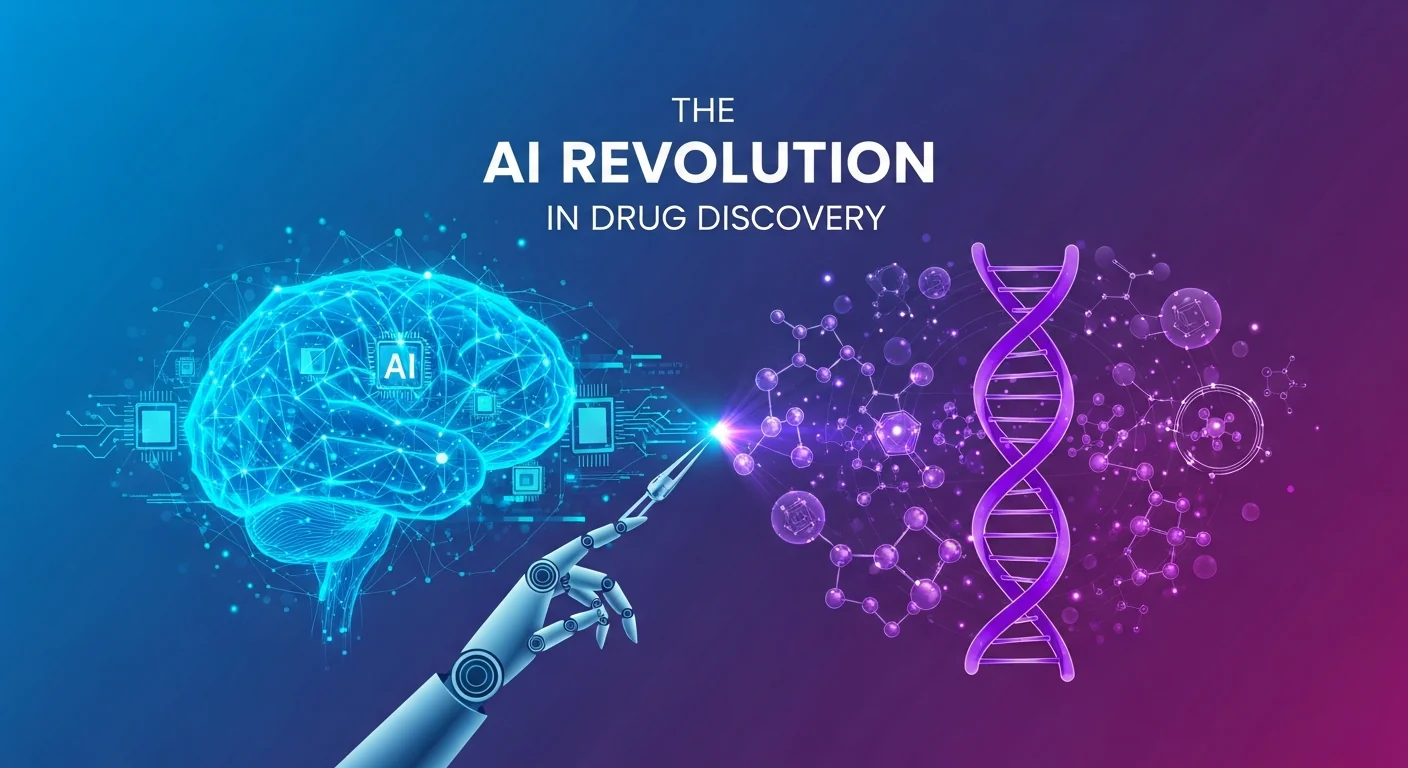

The brutal economics of drug discovery—a multi-billion dollar, decade-long gamble—are forcing the pharmaceutical industry to find a new edge. That edge is artificial intelligence. AI is being positioned to revolutionize the R&D pipeline by uncovering patterns in biological data that are simply invisible to the human eye. But for all the fanfare, a wide gulf still separates AI’s potential from its practical, on-the-ground deployment.
The Potential of AI-Driven Drug Discovery
From initial concept to final trial, AI is already starting to reshape every phase of drug development. Its impact is most tangible in four key areas:
- Target Identification and Validation: Unleashed on vast genomic, proteomic, and clinical datasets, AI algorithms can pinpoint the most promising biological targets for new drugs. Virtual simulations then allow researchers to validate these targets far more rapidly, ensuring only the highest-potential candidates move forward.
- Hit Identification and Optimization: Brute-force screening is giving way to intelligent searches. AI can scan immense chemical libraries for molecules with a high probability of binding to a target. Predictive models then forecast a compound’s activity, safety, and other critical properties, radically accelerating the optimization process.
- Preclinical Testing: Historical animal and clinical data can be transformed by AI into powerful predictive tools. These models can better forecast a drug’s efficacy and potential toxicity long before it reaches human subjects, leading to smarter trial designs and a lower risk of costly late-stage failures.
- Clinical Trials: In the high-stakes world of human trials, AI offers real-time analysis of incoming data, flagging early signals of efficacy or adverse events. This opens the door to truly personalized treatments by matching patient profiles to the most effective therapies, ultimately improving the odds of a successful outcome.
Limitations and Challenges of AI-Driven Drug Discovery
This revolutionary potential, however, is colliding with some harsh operational realities that are slowing widespread adoption.
- Data Quality: An AI model is only as good as the data it’s trained on. In drug discovery, datasets are frequently incomplete, inconsistent, or biased, directly undermining the accuracy of any prediction. Without robust, high-quality data pipelines, the entire endeavor is at risk.
- Interpretability of Algorithms: The “black box” nature of many deep learning models remains a major barrier. When an algorithm recommends a molecule or target without a clear scientific rationale, it erodes the trust required for researchers to act on its outputs. Explainable AI (XAI) is essential to bridge this critical gap.
- Regulatory Issues: The regulatory framework for AI-developed drugs has not kept pace with the technology. Regulators must urgently provide clear guidelines on safety validation, approval pathways, and ethical considerations to create a stable and predictable path to market.
- Cost Issues: Building and maintaining sophisticated AI infrastructure demands substantial investment in both specialized talent and high-performance computing. This high upfront cost is a formidable barrier, forcing companies into a difficult calculation on the long-term return.
The Present and Future of AI-Driven Drug Discovery
Today’s field is a study in contrasts, pitting established pharma giants integrating AI into existing pipelines against nimble biotech startups building their entire discovery engine around it. Early successes are already proving the technology’s value, from the discovery of novel antibiotics to significant reductions in clinical trial timelines.
Looking ahead, the convergence of more sophisticated algorithms with exponentially growing datasets will undoubtedly unlock profound efficiencies and entirely new therapeutic possibilities. But the core challenges—data integrity, model transparency, regulatory uncertainty, and cost—are not going to solve themselves. For the AI revolution in drug discovery to truly move from hype to hope, confronting these practical problems is not just an option. It is the only path forward.
