
AI Ignites a Memory Supercycle with HBM at the Epicenter
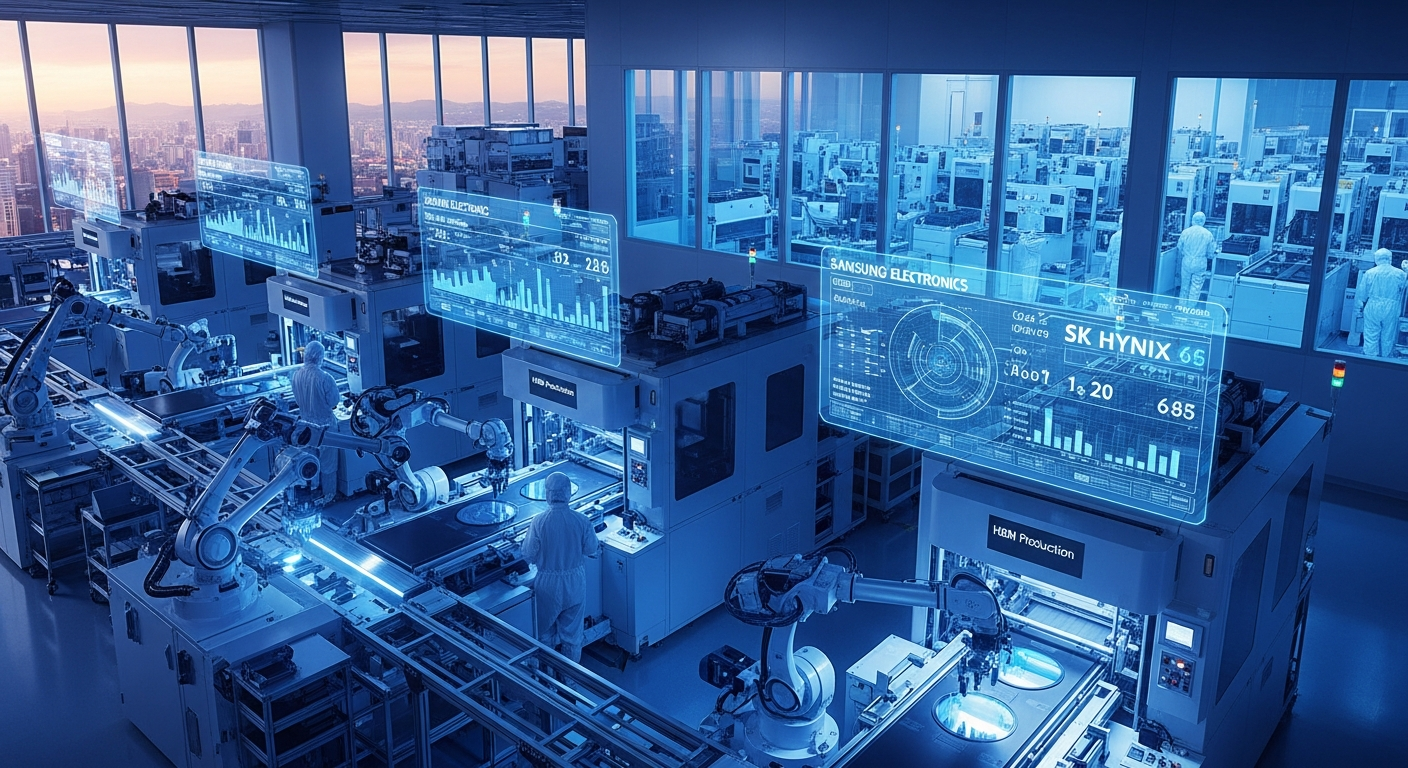
The global race to build AI infrastructure is fueling a memory supercycle, with high-bandwidth memory (HBM) at its core. Bank of America projects the HBM market will skyrocket 58% year-over-year, reaching a staggering $54.6 billion by 2026. This gold rush has ignited an all-out investment war between Korean titans Samsung Electronics and SK Hynix. Each is now pouring billions into HBM capacity expansion in a defining battle for leadership in the next generation of AI semiconductors.
A Multi-Billion Dollar Capital Injection
Leading the charge, SK Hynix has unveiled a $15 billion expansion plan for next-generation memory. A crucial piece of this strategy is a recent commitment of nearly $8 billion for advanced EUV lithography machines from ASML, slated for delivery by 2027, to fast-track its transition to the 1c DRAM process essential for HBM4. To further pad its war chest, the company is even eyeing a U.S. stock listing that could raise up to $10 billion. Samsung’s countermove is nothing short of overwhelming. The electronics giant has earmarked a record-shattering $73 billion (₩110 trillion) for chip capex and R&D in 2026 alone, aiming to boost HBM output by 50% to a monthly capacity of 250,000 wafers. This massive push centers on its Pyeongtaek facilities, specifically the P4 and P5 fabs.
The Battle for HBM4 Dominance
HBM3E may be the current standard, but the true battleground is HBM4. For now, SK Hynix holds a commanding lead with over 50% market share, fortified by its deep partnership with Nvidia. Yet Samsung, after stumbling with earlier yield issues, is staging an aggressive comeback. The company shocked the industry in February 2026 by announcing it had initiated the first-ever mass production of HBM4 chips. Whispers from the supply chain suggest its HBM4 samples even outperformed competitors in qualification tests for Nvidia’s next-gen Rubin platform, signaling a major technological turnaround. The stakes are higher than ever, as HBM4’s new architecture, which incorporates logic dies, presents immense manufacturing hurdles. The ultimate prize will go to whoever masters stable, high-volume production first.