
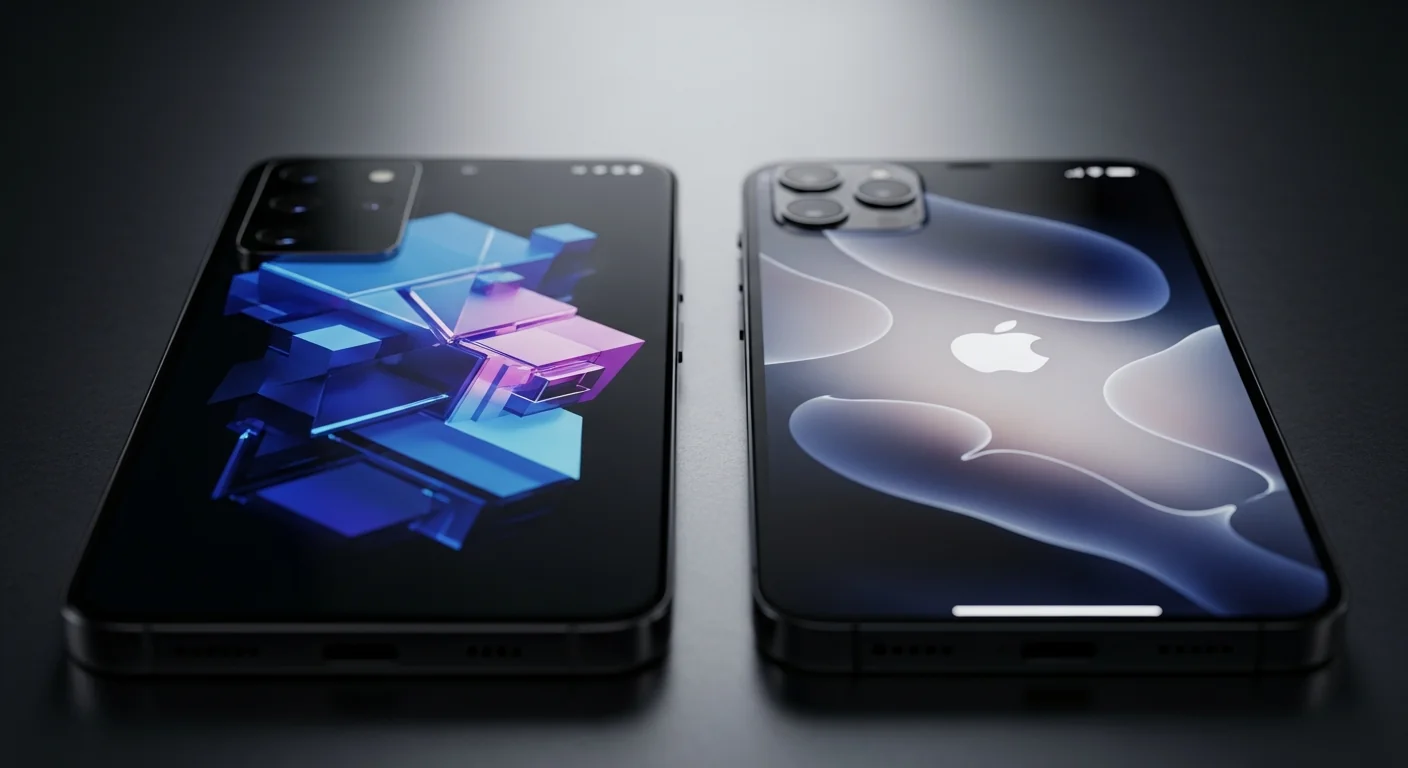

Galaxy S26 & iPhone 18: The Dawn of AI & Privacy Wars
With a staggering 85% of smartphone users now prioritizing data privacy, the industry has a new battleground. This is precisely where the Galaxy S26 and iPhone 18 are poised to compete, weaponizing advanced AI and uncompromising privacy safeguards to capture overwhelming market demand.
Deep Analysis: Technical Superiority & Market Impact
How it Works: The two giants are taking fundamentally different strategic paths. Samsung’s Galaxy S26 places its bets on a powerful on-device AI chipset, handling everything from real-time translation to custom security locally and eliminating cloud data leak risks. Apple, in the other corner, is doubling down on the iPhone 18’s fortress-like security architecture, combining end-to-end encryption with new AI-driven anomaly detection to preemptively neutralize threats. While the S26 leverages an upgraded neural engine for speed, the iPhone 18 reinforces its Secure Enclave, rooting privacy directly into the hardware.
Market Impacts:
- Premium Smartphone Market Expansion: Expect the premium segment to swell by over 20%. This AI-security arms race between the S26 and iPhone 18 will give privacy-conscious consumers a compelling reason to upgrade without hesitation.
- Standardization of Security & AI Technologies: Their rivalry will establish new industry benchmarks, forcing competitors to play a frantic game of catch-up. The immediate consequence is a rising tide of security and AI standards across the entire market.
- Intensified Competition in Data-Driven Services: As both flagships roll out sophisticated AI-personalized services, the battle over data governance will heat up, likely triggering stricter regulations. Gartner’s forecast of a 50% jump in corporate privacy fines by 2025 underscores the high stakes.
Competitor Comparison: In this new landscape, competitors are left scrambling. Google’s Pixel boasts impressive AI in photography and voice assistance, but it simply can’t match the robust on-device privacy controls of Samsung and Apple. Xiaomi continues to capture market share through aggressive pricing, yet its offerings lack the sophisticated security and AI depth of the two leaders. Ultimately, the Pixel 9’s reliance on the cloud and the Xiaomi 15’s trade-off of security for cost leave them dangerously vulnerable.
Reliable Statistics:
- According to Statista, the global smartphone market size reached $480 billion in 2024.
- A Pew Research Center survey found that 79% of U.S. adults are concerned about data privacy.
- Counterpoint Research forecasts that the premium smartphone market will account for 30% of the total market in 2025.
3 Steps You Should Take Now
- Audit Your Privacy Settings: Go to your phone’s privacy dashboard and revoke permissions for any app that overreaches.
- Never Skip a Security Update: Install OS and app updates the moment they arrive. They contain critical security patches that shield you from the latest threats.
- Be Skeptical of AI Services: Before enabling any new AI-powered feature, vet its privacy policy. Understand exactly how your data will be used.
Future Prediction (1 Year)
Fast forward one year, and the market will be firmly in the grip of the Galaxy S26 and iPhone 18, which will have set a new gold standard for AI and security. The critical shift will be the maturation of on-device AI, enabling powerful features to run entirely offline. This move will not only alleviate consumer data privacy fears but also fundamentally change how we interact with our most personal devices daily.
