
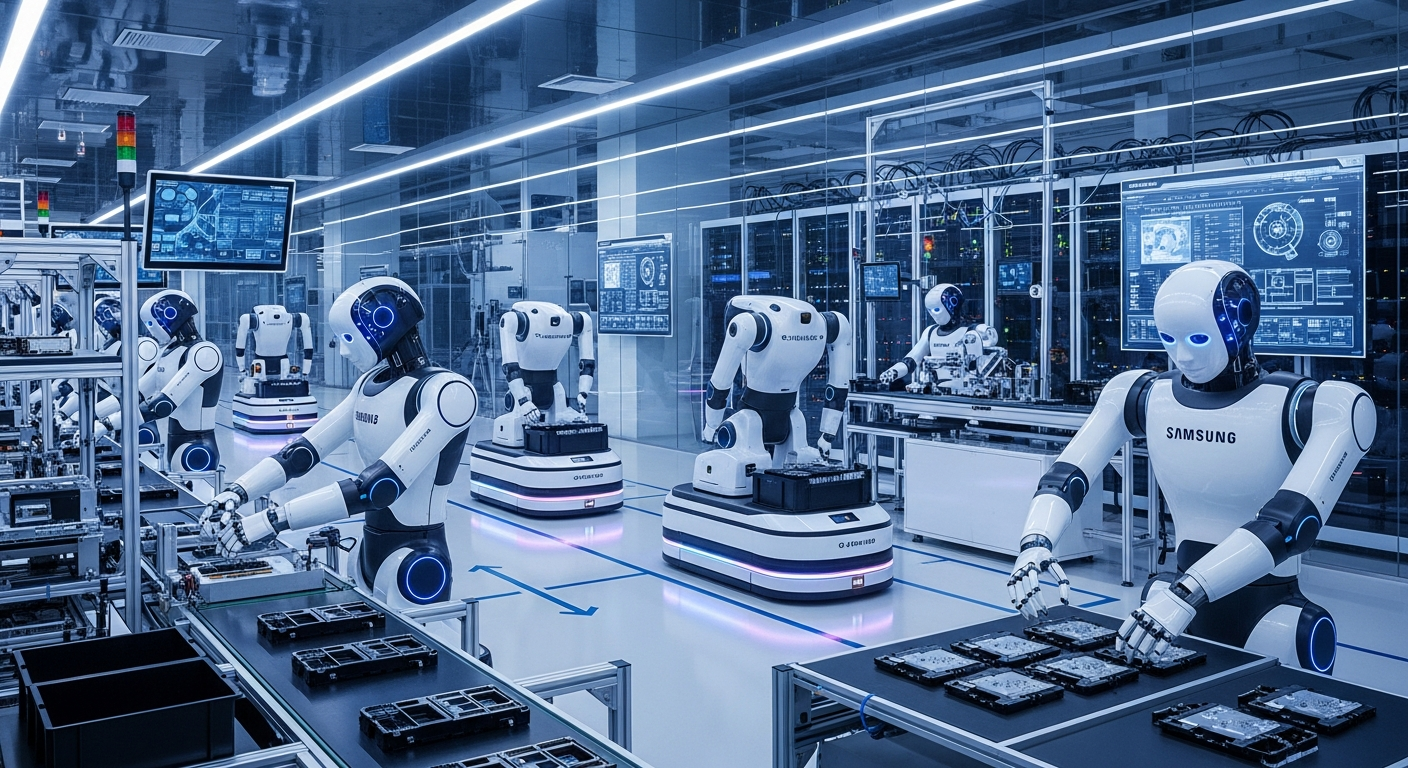

Samsung Accelerates Transformation to AI Autonomous Factories by 2030
By 2030, Samsung plans to transform its global production sites into fully autonomous factories driven by artificial intelligence. This ambitious roadmap hinges on integrating Agentic AI, reportedly from the upcoming Galaxy S26, and humanoid robots into every stage of production. The initiative is already taking root in the complex semiconductor sector, where AI dissects vast streams of real-time data to optimize operations.
Technical Analysis
At the core of this strategy are two technological cornerstones. Agentic AI, powered by the Galaxy S26, will analyze production data in real time, preemptively identifying bottlenecks and boosting overall efficiency. Simultaneously, humanoid robots are slated to take over hazardous and repetitive tasks, which not only mitigates risks for human workers but also significantly increases output. This dual approach is designed to cement Samsung’s manufacturing dominance.
Market Analysis
This move comes as the global smart manufacturing market, fueled by AI, is exploding. Projections from Statista show the market reaching $285 billion in 2024, with an annual growth rate exceeding 12%. Samsung’s aggressive push into autonomous factories is a clear strategic play to capture this growth and solidify its leadership position.
Strategic Insight
Make no mistake, this is more than a simple technology upgrade; it’s a fundamental reimagining of the manufacturing process itself. The fusion of AI and robotics promises not just to cut costs and boost productivity but also to enhance product quality and address persistent labor shortages. This agility will enable Samsung to respond to shifting customer demands with unprecedented speed, offering customized production from highly flexible manufacturing lines.
Data & Evidence
The feasibility of this 2030 vision isn’t just theoretical. Within its existing semiconductor operations, Samsung has already deployed AI for defect detection, slashing error rates by over 50% and reducing process times by 20%. These concrete results provide a powerful proof-of-concept, demonstrating the tangible benefits that justify a full-scale rollout.
Actionable Conclusion
Samsung’s roadmap isn’t just an internal plan; it’s a new benchmark for the entire manufacturing industry. The synergy between AI and robotics is set to deliver a powerful combination of efficiency gains and a strengthened competitive moat. Industry observers should pay close attention to Samsung’s next moves, as strategic partnerships with leading AI and robotics firms now seem not just likely, but inevitable.