
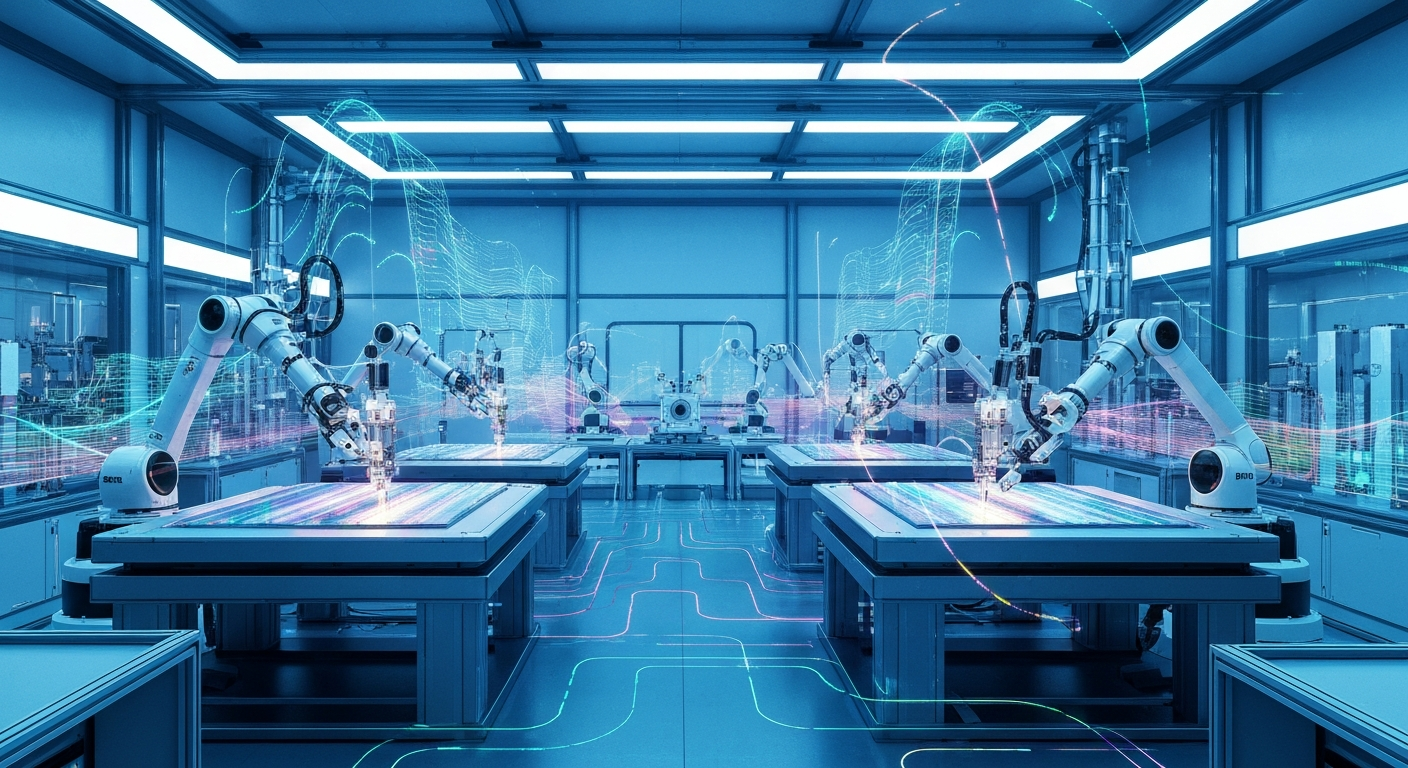

Autonomous Labs Emerge: AI Propels Scientific Discovery at Unprecedented Speeds
Traditional scientific research, from novel material development to drug discovery, has historically demanded immense time and capital. For instance, manually analyzing vast X-ray datasets could take months, while aligning cutting-edge X-ray facility beamlines often consumed hours. This paradigm is now fundamentally shifting with the advent of AI-driven autonomous laboratories. The U.S. National Science Foundation (NSF) underscores this sector’s importance, investing $380 million in AI-powered research labs as part of its ‘Genesis Mission,’ aiming to double the pace of scientific discovery within a decade.
Central to this transformation is the ‘AI X-ray scientist,’ recently developed by researchers at Northeastern University and SLAC National Accelerator Laboratory. This AI system autonomously sets up and executes X-ray experiments, critically adapting its approach based on real-time data and observations. Functioning as an ‘agent’ rather than merely following prescribed instructions, it reasons through problems and flexibly alters its strategy, mitigating the need for constant human oversight. This capability holds significant potential to alleviate the complexities and costs associated with traditional X-ray scattering experiments conducted at massive synchrotron accelerator facilities.
Automation in research extends beyond experiment execution. Argonne National Laboratory has pioneered AI-driven systems like ‘AI-NERD’ to dramatically accelerate X-ray data analysis. Modern detectors generating up to 50 gigabytes of X-ray data per second create an insurmountable bottleneck for manual processing. AI-NERD automatically learns and recognizes material behavior patterns within these colossal datasets, completing analyses in days that previously required months. Furthermore, the ‘AutoFocus’ system reduces X-ray beam alignment time from several hours to just ten minutes, allowing scientists to dedicate more time to core discoveries rather than equipment management. These technologies enable the detection of microscopic changes previously missed, offering unprecedented real-time observation of material transformations.
Self-driving laboratories (SDLs), which integrate machine learning, robotics, and automation with chemical and materials sciences, accelerate novel material discovery by a factor of 10 to even 100 times. This will condense development timelines for materials across various industries—including batteries, aerospace, electronics, clean energy, and semiconductors—from years to mere weeks or days. The resulting cost reductions and efficiency gains in the materials discovery process will directly impact market dynamics, maximizing returns on research and development (R&D) investments. The emerging ‘SDL 2.0’ concept aims for globally networked platforms that are interoperable, collaborative, generalizable, orchestrated, safe, and creative, democratizing scientific research and accelerating innovation.
These advancements carry significant implications for technology and financial markets. Corporations must closely evaluate investments in AI-driven autonomous laboratory technologies and proactively pursue strategies to integrate AI into their R&D workflows. Forging partnerships with leading research institutions will prove critical for securing a competitive edge. The evolution of autonomous lab technologies represents more than just an efficiency boost; it enables scientific breakthroughs previously unimaginable, driving innovation across entire industries. Investors should monitor the growth potential of this nascent field, focusing on companies and research initiatives at the forefront of this transformative technology.
- AI Scientist
- Self-Driving Labs
- X-ray Experiments
- Materials Discovery
- R&D Automation
References & Sources
