
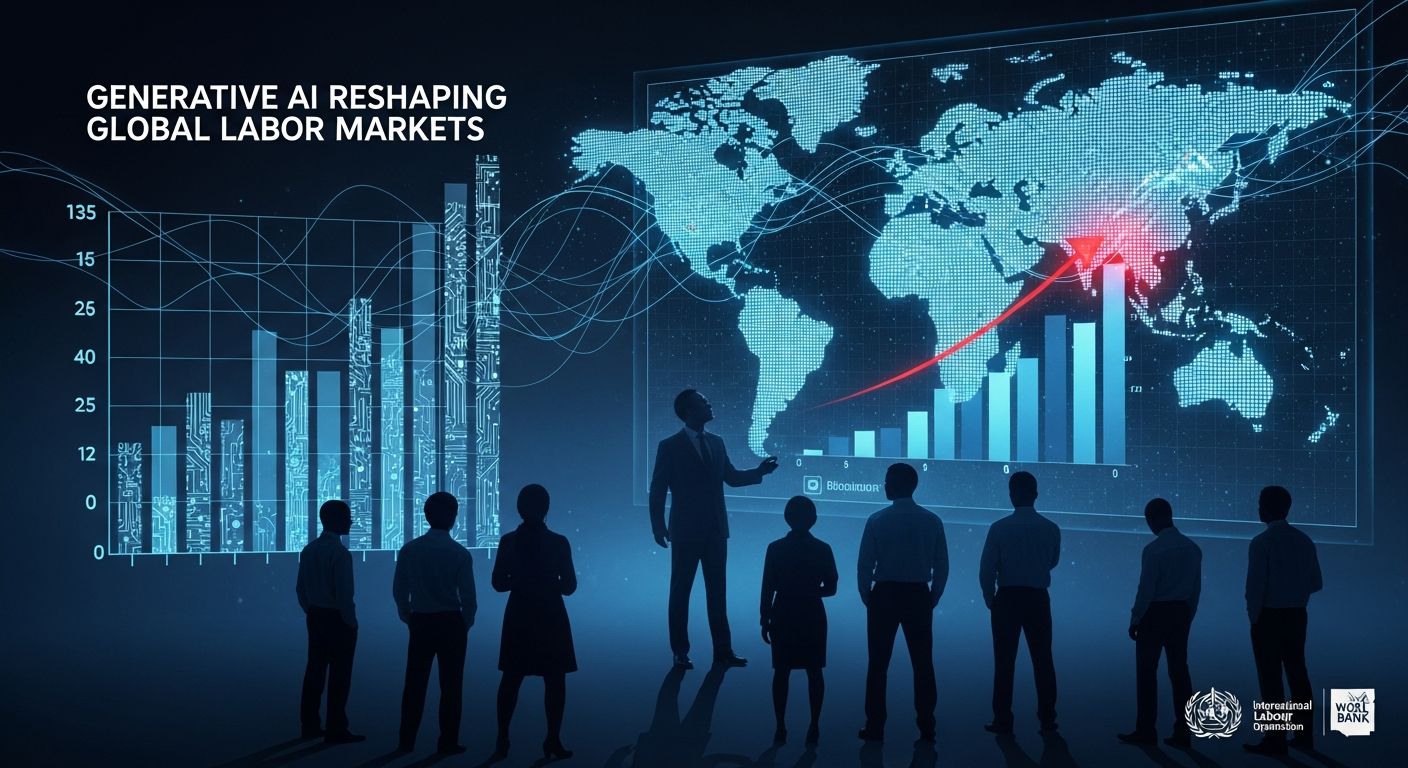

A Fork in the Global Labor Market
A new joint paper from the International Labour Organization (ILO) and the World Bank, analyzing 135 countries, lays bare the uneven impact generative AI will have on roughly two-thirds of global employment. While around 30-32% of employment in high-income countries is exposed to GenAI, that figure is only 10-15% in low-income nations. The critical insight, however, is that the greater peril lies with the less-exposed developing economies. They now face a scenario of “disruption without dividend,” where the negative shocks of automation may materialize long before any productivity gains.
Data Evidence: The Asymmetric Shock
The core of the report analyzes a stark paradox rooted in structural constraints and the digital divide. This dynamic is best described as one of a “small buffer, big bottlenecks”. Workers in jobs vulnerable to automation, such as clerical and administrative positions, are often already online even in low-income settings, meaning displacement can happen relatively quickly. These roles often represent the higher-quality formal sector jobs that have historically provided a pathway to decent work, particularly for women and young workers. GenAI threatens to kick that ladder away.
Conversely, many workers in roles with the potential for productivity augmentation lack the reliable internet access needed to benefit from the technology. Compounding the issue, even within similarly titled occupations, workers in lower-income economies perform fewer non-routine analytical tasks and more manual or routine work. This fundamentally reduces the scope for GenAI to deliver productivity gains. The risk is a “white-collar bypass,” where the office-based jobs that supported upward mobility in advanced economies may not fully materialize in developing countries.
Forward Projection and Actionable Conclusion
This data-driven projection indicates that GenAI is set to widen the economic chasm between advanced and developing nations. A country’s future will be determined not just by technology adoption, but by its digital infrastructure, human capital, and the very composition of its work tasks. Nations that fail to address these infrastructure and skills gaps will face deepening inequality and potential social instability.
Ultimately, investors and policymakers must watch for these imperatives:
- Reassess Risk: Sovereign and corporate risk must be re-evaluated based on a country’s digital readiness and workforce adaptability.
- Target Investment: Investment in digital connectivity, ed-tech, and skills development platforms in emerging markets is no longer optional but essential.
- Drive Policy: Governments must urgently strengthen social safety nets and implement policies for digital inclusion and lifelong learning. The key metric to watch going forward is not AI adoption alone, but the ratio of augmentation potential to automation risk, country by country.