
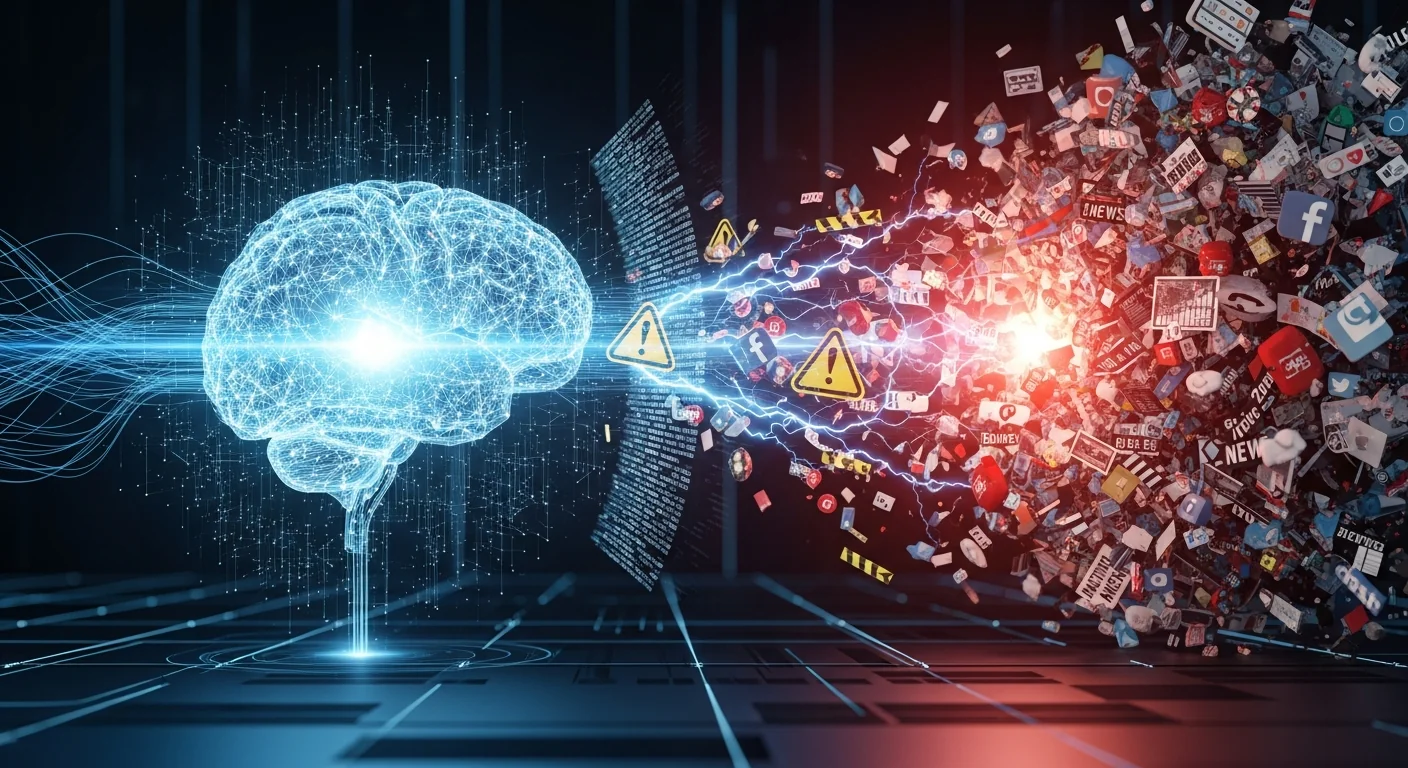

Urgent Need for UK AI Crisis Response to Counter Disinformation
In the critical hours following a major crisis, a staggering 60% of circulating information is false. This is a familiar problem, but AI has supercharged it, spreading disinformation at a velocity that overwhelms traditional safeguards.
In-Depth Analysis
Technical Underpinnings: Sophisticated deep learning models are the engine behind this threat. They fuel disinformation campaigns capable of manipulating text, images, audio, and video with terrifying precision. Generative Adversarial Networks (GANs), for instance, are trained on immense datasets to generate synthetic content so convincing it can flawlessly mimic reality or invent entirely new, believable material.
Market Impacts:
- Political Impact: The damage is far from theoretical. We’ve already seen false narratives sway elections and ignite social unrest. Analysis now suggests AI-generated disinformation could suppress voter turnout by as much as 5% in critical contests.
- Economic Impact: A single fabricated story can obliterate market confidence. A 2023 incident proved this when a fake news report wiped 10% off a company’s share price, a stark demonstration of how vulnerable corporate reputations have become.
- Social Impact: During a crisis, misinformation becomes lethal. It fractures community trust, delays life-saving emergency responses, and directly compounds casualties. In the chaos that follows, fear spreads as fast as any fact.
Competitor Comparison:
- Google: The company’s detection tools are deployed, but they are simply not eliminating disinformation at the scale required.
- Meta: Partnerships with fact-checkers show promise, but the reality is stark: AI-generated content is evolving much faster than their countermeasures can adapt.
Key Statistics:
- Research from MIT confirms it: fake news travels a staggering 6 times faster than factual reports.
- An Oxford University study found that AI now powers 70% of global disinformation campaigns.
- The public is losing its ability to discern truth. A Pew Research Center study found 64% of Americans now struggle to tell fake news from real.
Action Guide: 3 Steps to Take Now
- Government: Establishing clear legal and regulatory frameworks is the essential first step. The UK government has signalled its intent to regulate AI, but it must now prioritize crisis-specific protocols that allow for decisive action when a threat emerges.
- Businesses: Passivity is not an option. Companies must proactively deploy advanced AI detection systems and build alliances with fact-checking organizations to neutralize false narratives before they go viral.
- Individuals: The public forms the final line of defense. Developing sharp media literacy and rigorously verifying sources before sharing is no longer just good practice—it’s a fundamental civic duty.
Future Prediction (1-Year Outlook)
Within a year, the line between synthetic and authentic media will blur to the point of being indistinguishable for the average person. This isn’t a distant threat; it’s an imminent reality. Government and the private sector must accelerate investment in detection technology *now*, while simultaneously launching aggressive education campaigns to build public resilience. The race is on.
