
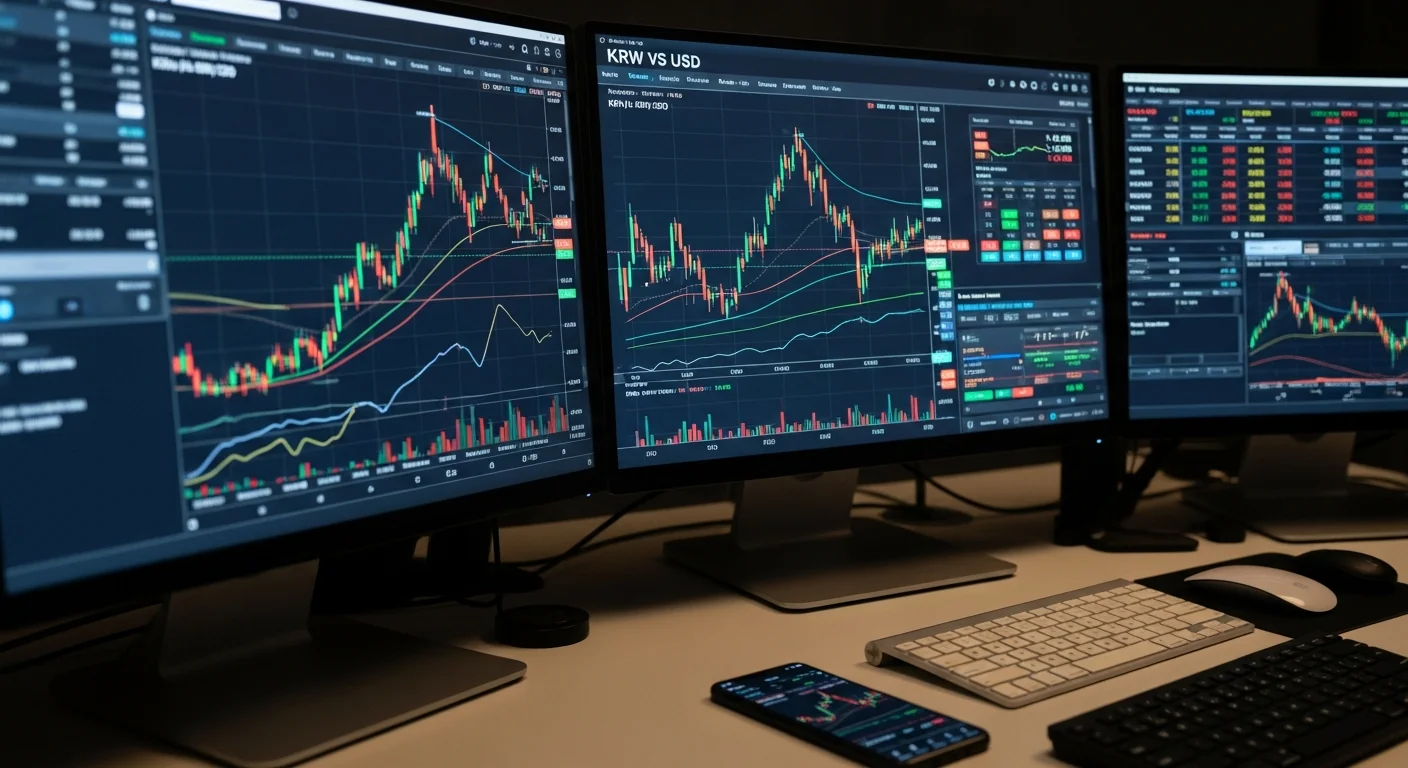

A surprise surge in the U.S. January Producer Price Index (PPI) ignited a dollar rally, but a concurrent drop in U.S. Treasury yields capped the ascent. This tug-of-war sent the Korean won on a volatile ride, touching 1445 before settling just on the 1440 line. These conflicting indicators have created a complex and uncertain market landscape that demands a closer look.
1. Opening Market: Volatility Spikes, Won Ends at 1440
Inflation fears radiating from the U.S. rocked foreign exchange markets, dramatically widening the day’s trading range. While the hotter-than-expected PPI spurred a flurry of dollar buying, the retreat in Treasury yields put a ceiling on the won’s losses, leading to a tense battle that ultimately concluded at the 1440 mark.
2. In-Depth Analysis:
2.1. Technical Analysis
The won is currently trapped in a 1400-level box. In the short term, 1420 is proving to be a solid floor, while 1450 acts as a clear ceiling. Although technical indicators are flashing neutral, the recent surge in volatility makes it dangerous to call a definitive trend just yet.
2.2. Market Psychology
Investors are caught in a crosscurrent, torn between hopes for a less aggressive Federal Reserve and fears of a global recession. The recent string of mixed economic data from the U.S. has only amplified this uncertainty, putting a palpable chill on market sentiment and leaving traders without a clear directional narrative.
2.3. Macroeconomic Backdrop:
U.S. Economy: Service-sector inflation was the main culprit behind the January PPI surge. This is a clear signal that price pressures are stickier than many had hoped, lending weight to the view that the Fed’s tightening cycle could last longer than the market currently anticipates.
Korean Economy: Korea’s economy is grappling with the dual challenge of cratering exports and sluggish domestic demand. The sharp decline in semiconductor shipments remains the primary weak spot. On the other hand, expectations are growing that active government stimulus measures, including a potential supplementary budget, could provide a floor for the won and prevent a steeper slide.
3. Strategic Implications:
3.1. Risk Management
In a market this volatile, managing risk is paramount. Investors must actively use currency hedging tools or employ dollar-cost averaging strategies to protect against unexpected losses. This is not a market for complacency.
3.2. Maintaining a Long-Term View
It’s crucial to look past the short-term noise and focus on long-term fundamentals. For those who believe the won is excessively undervalued relative to the Korean economy’s underlying strength, the current weakness could present a strategic buying opportunity.
3.3. Information Flow
Staying ahead requires an intense focus on incoming data. Key variables that will dictate the market’s next move—from U.S. economic indicators and shifts in the Fed’s rhetoric to geopolitical flare-ups—must be swiftly incorporated into any trading strategy.
4. Conclusion: A Time for Caution and a Long-Term Game
Conflicting signals from the PPI jump and the bond market retreat have thrown the currency market into disarray. In this environment, investors need to see the forest for the trees. Rigorous risk management and portfolio diversification are non-negotiable. The best course of action is to closely track macroeconomic trends and market psychology to identify the right entry and exit points, while keeping a potential return to the 1300s as a viable scenario.
The only certainty in the unpredictable world of foreign exchange is that a prudent approach pays dividends.
[참고 문헌 및 출처]
- seoulwire.com
- benzinga.com
- einfomax.co.kr
참고문헌
- >vertexaisearch.cloud.google.com – blockmedia.co.kr
>vertexaisearch.cloud.google.com – sbs.co.kr
References & Sources
