
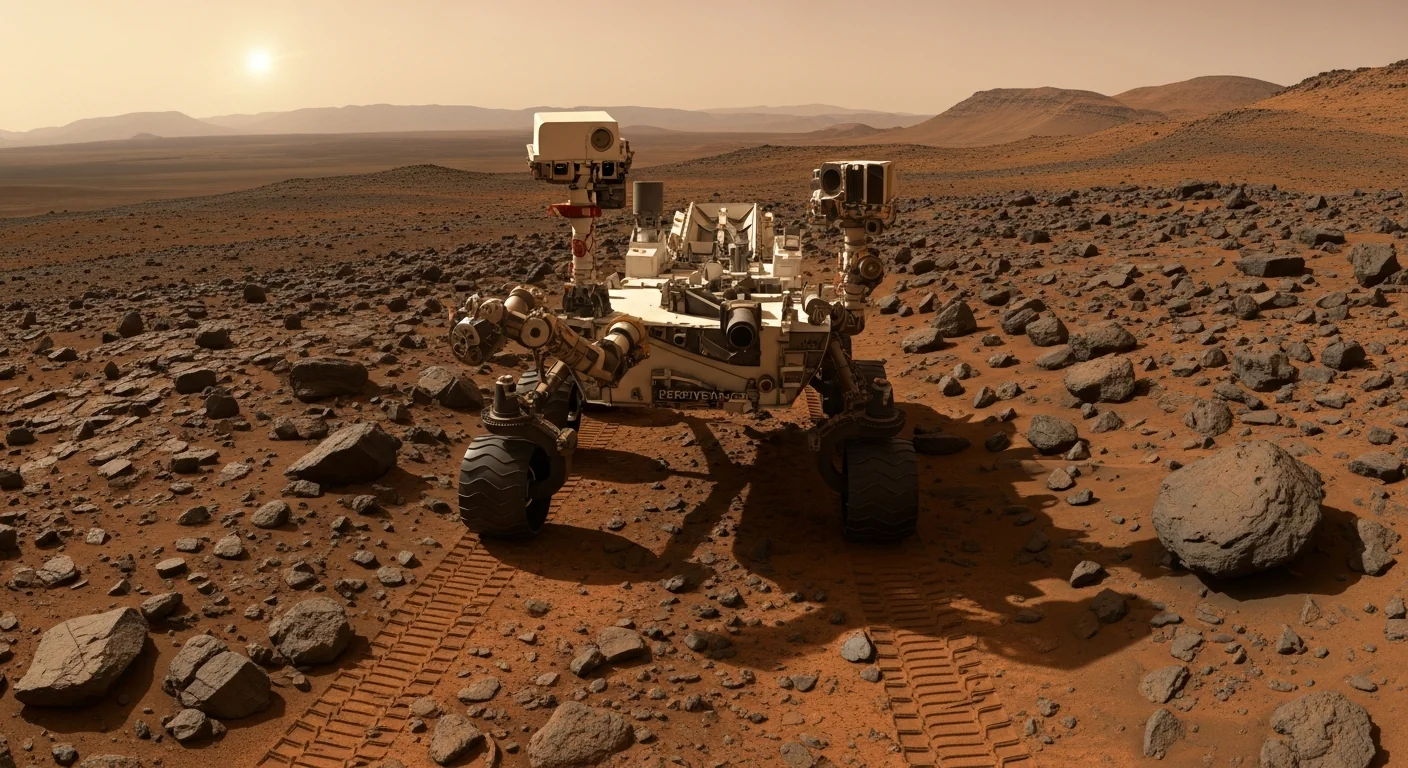

NASA’s Perseverance Rover Sets New Mars Exploration Records with AI-Powered Autonomous Driving
AI Forges a New Frontier in Mars Exploration
A new driving record has just been set on Mars, and the star of the show is NASA’s Perseverance rover. Gone are the days of human operators painstakingly plotting every turn. Today, AI is at the helm, making autonomous decisions to maximize exploration efficiency.
At the heart of this achievement is the AutoNav system, an AI capable of real-time environmental analysis. This allows Perseverance to autonomously dodge obstacles and chart the most efficient course. The result is a staggering increase in travel distance—a leap of up to 10 times compared to the mere tens of meters covered per day by older rovers.
How the AutoNav System Works
The mechanics behind AutoNav are remarkably sophisticated. The system instantly processes images from its cameras to generate a 3D terrain map. From there, it identifies hazardous obstacles and calculates the safest, most direct path forward.
This capability allows the rover to navigate treacherous canyons and rock-strewn fields without waiting for commands from Earth. The direct consequence? An explosive increase in the volume of scientific data being collected.
The Advantages of AI-Powered Autonomy
The advantages of AI-powered autonomy in Martian exploration extend far beyond mere ‘efficiency improvements’.
- Increased Exploration Speed: By minimizing the need for human intervention, the system slashes decision-making time and pushes the rover to its operational limits.
- Expanded Operational Range: The rover can now cover vastly more ground, dramatically increasing the probability of making key scientific discoveries.
- Greater Resource Efficiency: It lessens the workload for the ground control team, freeing them to concentrate on high-priority scientific analysis.
- Enhanced Mission Safety: The rover can autonomously navigate and secure itself in unpredictable, hazardous terrain, significantly reducing mission risk.
Impact on the Future of Mars Exploration
The success of AutoNav is more than a win for a single rover; it represents a complete paradigm shift for Martian exploration. This technology is now set to become a standard feature on future rovers, promising a quantum leap in both exploration efficiency and mission safety.
But the applications don’t stop at Mars. This autonomous navigation technology will be critical for missions to the Moon and even distant asteroids. We are witnessing the arrival of a powerful tool poised to rewrite the history of human space exploration.
Conclusion
Perseverance’s autonomous driving achievements deliver an unmistakable message: AI is no longer a mere auxiliary tool in space exploration but its core engine. We’ve officially entered an era where deep-space missions without AI are simply unimaginable.
