
NASA’s Perseverance Rover Sets New Mars Exploration Record with AI-Powered Autonomous Driving
AI Pioneers a New Era in Mars Exploration
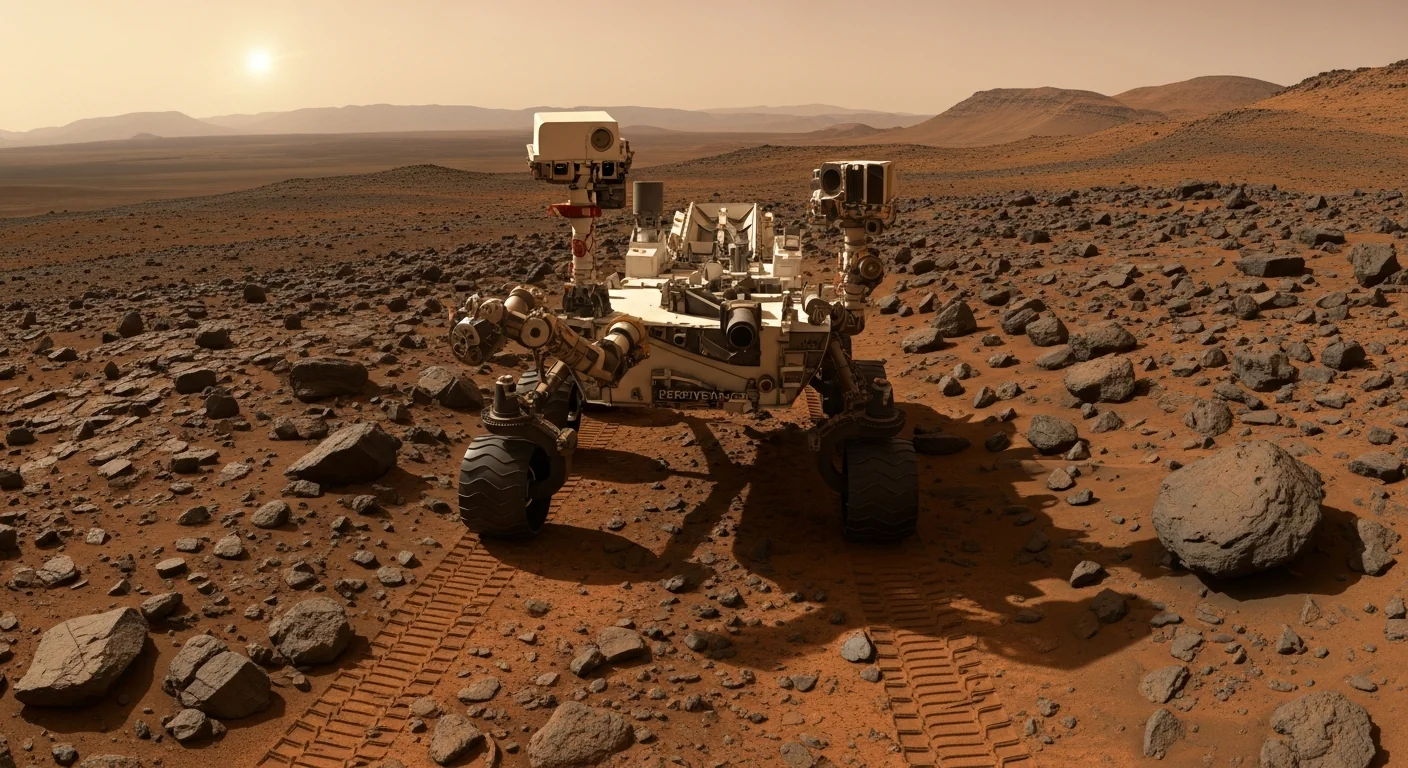
In a landmark achievement for interplanetary exploration, NASA’s Perseverance rover has navigated a path on Mars planned entirely by artificial intelligence. This milestone, accomplished in December 2025, saw the rover traverse a total of 1,496 feet (456 meters) of Martian terrain, marking a decisive break from three decades of manual route planning and handing the operational reins to generative AI.
Harnessing vision-language AI models, the system meticulously analyzes orbital imagery and terrain data to identify hazards like boulder fields and sand traps, charting a safe course. As JPL space roboticist Vandi Verma states, “The fundamental elements of generative AI are showing a lot of promise in streamlining the pillars of autonomous navigation for off-planet driving: perception (seeing the rocks and ripples), localization (knowing where we are), and planning and control (deciding and executing the safest path).”
How the AI System Works
A joint effort between JPL and Anthropic drove this demonstration, utilizing powerful Claude AI models for the task. The AI processed high-resolution orbital images from the Mars Reconnaissance Orbiter’s HiRISE camera, converting them into detailed digital elevation models. From that data, it identified obstacles such as rocks, ripples, and bedrock outcrops before generating a series of safe waypoints.
Before a single command reached Mars, engineers put the plan through its paces on a “digital twin” of the rover, validating over 500,000 telemetry variables to guarantee safety. Only then did Perseverance’s onboard auto-navigation system take over on the Red Planet, executing the plan by processing images in real time. The successful drives covered 689 feet (210 meters) on December 8 and another 807 feet (246 meters) just two days later.
Advantages of AI-Powered Autonomous Driving
For decades, the communication delay between Earth and Mars has been the fundamental bottleneck for rover exploration. This lag limits human-planned routes to roughly 100 meters per waypoint, a consequence of the painstaking process of analyzing images back on Earth. AI completely shatters this dynamic. It empowers the rover to navigate complex terrain efficiently, promising a dramatic increase in its scientific output.
- Faster Decision-Making: Eliminates the Earth-Mars communication lag, enabling real-time adjustments on the planet’s surface.
- Extended Range: Makes kilometer-scale traverses possible, opening up previously inaccessible regions for study.
- Improved Safety: AI algorithms can detect subtle hazards in terrain data that human operators might overlook in 2D images.
- Enhanced Science Returns: Covering more ground directly translates to collecting more diverse and valuable scientific data.
Implications for Planetary Exploration
This technological success carries immediate and far-reaching implications. Future rovers will undoubtedly integrate more advanced autonomous navigation, potentially even deploying swarms of AI-guided drones to explore Mars concurrently. In the near term, the focus will shift to refining the AI’s ability to match orbital data with ground-level imagery for even more precise localization.
But the breakthrough extends far beyond Mars. The same technology is directly applicable to missions on the Moon, asteroids, and other celestial bodies where communication delays or harsh conditions make human-in-the-loop control impractical. The December 2025 test drive will almost certainly be remembered as the pivotal moment that redefined interplanetary exploration.
Conclusion
Perseverance’s AI-powered drives are nothing short of a paradigm shift for space operations. By proving that generative AI can safely and effectively handle complex navigation tasks once reserved for human experts, NASA has opened an entirely new chapter in robotic missions. Autonomous systems are no longer a distant concept; they are a proven technology, poised to become standard equipment on the next generation of planetary rovers.
