
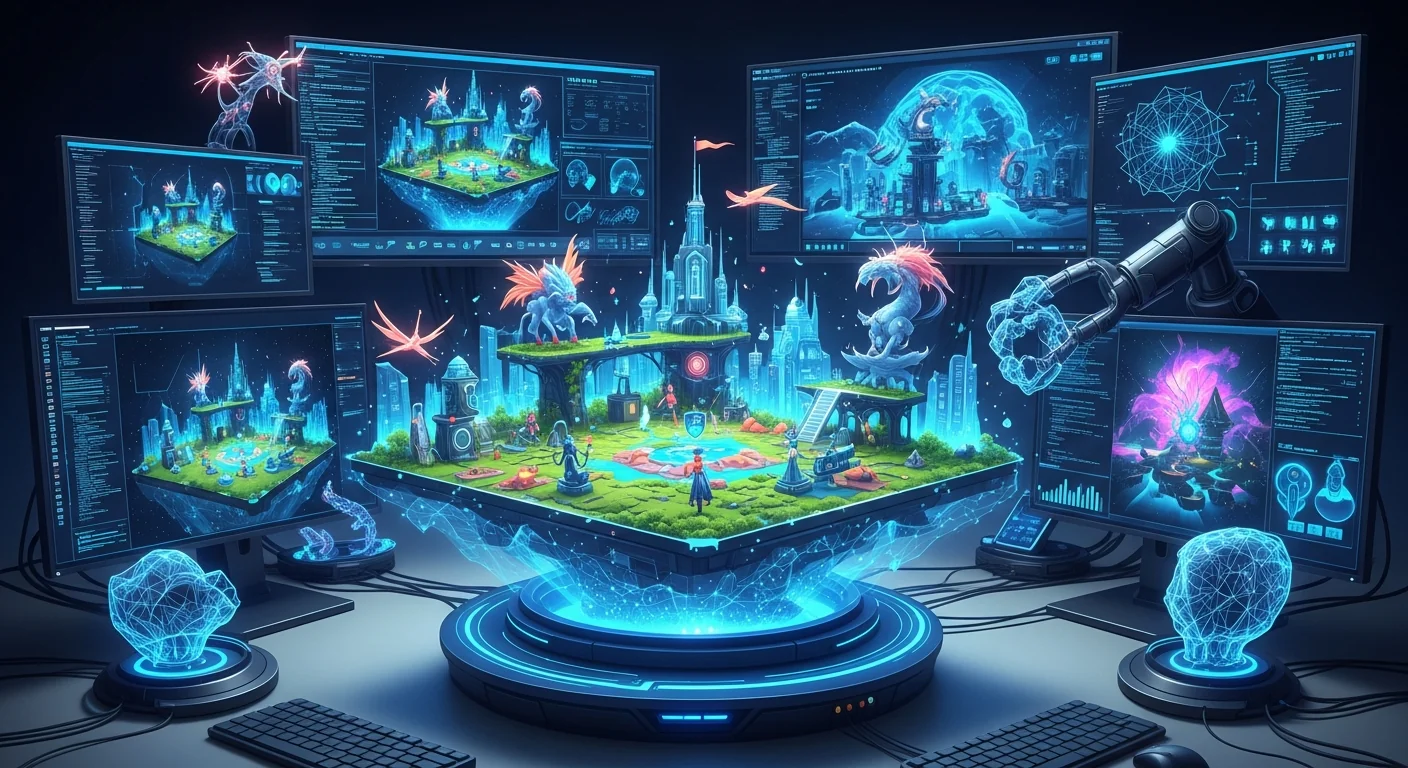

AI is fundamentally reshaping the economics of game development. Studios are already reporting a 30% efficiency boost, driven by automation and intelligent workflows. This transformation is not isolated to one area; it’s sweeping across the entire development pipeline, from prototyping and asset creation to testing and live operations.
AI Redraws the Industry Map
Having moved far beyond the experimental phase, AI technology is now a core production tool. By 2026, AI will handle mission-critical tasks like procedural content generation (PCG), advanced NPC behavior systems, and automated quality assurance (QA), directly impacting release schedules and revenue by significantly reducing friction in the production process.
Technical Analysis
On the ground, development teams are aggressively deploying generative AI for asset production, procedural level design, and reinforcement learning-based NPC systems that adapt to player behavior. This is no longer a peripheral experiment but a central component of how teams build and iterate on games. PCG technology not only shortens production timelines but also frees designers from repetitive asset work, allowing them to focus on creative problem-solving. Advanced NPC dialogue systems built on agent AI frameworks have cut generation time by an impressive 40%, while reinforcement learning is creating intelligent adversaries that evolve alongside the player, offering constantly new challenges.
Market Impact & Key Statistics
- Development Velocity & Cost: AI-driven automation is slashing development timelines, reducing pre-launch bug discovery rates by over 50%. Across the board, studios confirm a 30% efficiency gain in their pipelines, with automated QA systems identifying critical bugs 70% faster than manual testing.
- Player Retention: AI-powered customer engagement strategies are boosting retention by as much as 25%. Dynamic difficulty systems, which adjust challenges to individual skill levels in real-time, are completely replacing older, cruder methods. Personalized content and recommendation engines have already led to a 10% increase in in-game purchases.
- Revenue & ROI: Sophisticated AI target marketing optimizes ad spend and maximizes campaign performance. Studios leveraging these strategies are achieving significantly higher corporate valuations compared to competitors still relying on traditional methods.
The adoption rate is staggering: more than one in three industry professionals has already integrated generative AI tools into their workflow. This momentum is reflected in the market’s explosive growth, projected to surge from approximately $2.87 billion in 2023 to $16.56 billion by 2032, with a compound annual growth rate (CAGR) of 40.7% through 2030.
Competitive Landscape
Market leader Unity Technologies is focused on shortening iterative development cycles by integrating AI-powered code generation and asset creation features directly into its engine. Its primary competitor, Epic Games, continues to bolster the AI capabilities of its Unreal Engine, with the ‘Metahuman Creator’ tool in particular revolutionizing the high-fidelity character creation process.
Three Essential Strategies for Immediate Action
- Build In-House AI Expertise: Do not wait for a perfect, off-the-shelf solution. Start building hands-on experience with current AI tools and frameworks now. The key is to hire specialists and train existing staff on practical applications.
- Integrate AI into Core Workflows: Begin with high-ROI areas like QA automation, asset generation, and player support systems. A phased approach is most effective: measure concrete outcomes, such as reduced cycle times or faster support ticket resolution, and expand from there.
- Construct a Robust Data Infrastructure: A solid system for collecting and analyzing player data is the bedrock of personalized experiences. Refined telemetry data not only fuels AI model training but also provides the critical insights needed to determine which features drive retention.
The 12-Month Outlook
Over the next year, expect real-time difficulty scaling and NPC dialogue systems to become even more sophisticated. As hardware improvements make on-device AI inference more common, latency issues in multiplayer games will be significantly mitigated. In marketing, AI-driven personalization will shift from a differentiator to a standard expectation. Ultimately, the studios that achieve the greatest success won’t be the ones chasing flashy demos, but those that systematically integrate AI into a reliable, measurable production system.
