
Managing 100 AI Colleagues Is the Future of Work
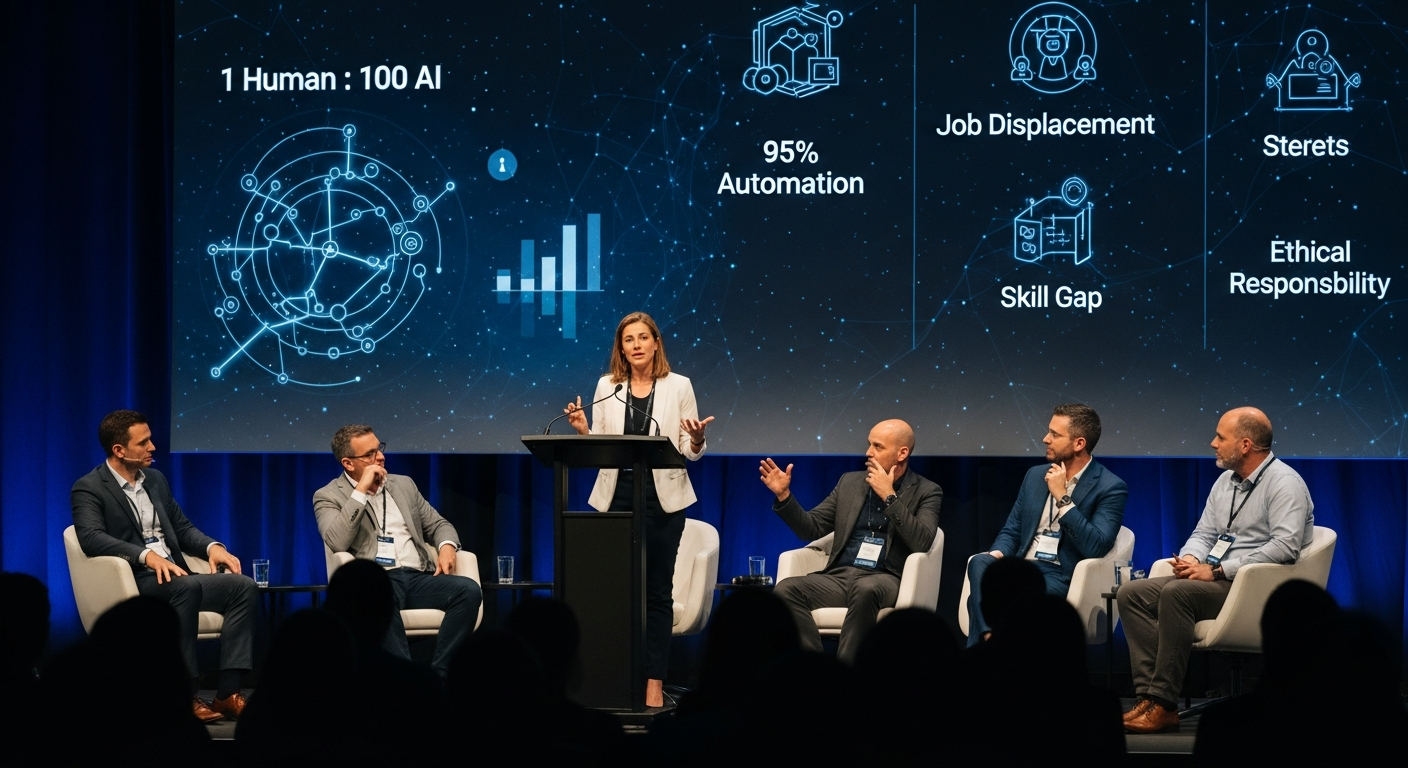
NVIDIA CEO Jensen Huang’s vision of a single employee managing 100 AI agents is rapidly becoming reality, not science fiction. Look at McKinsey: the firm already operates with 25,000 AI agents supporting its 40,000 human employees. This emerging digital workforce isn’t just about simple task assistance; it represents a profound operational shift that will fundamentally reshape corporate structures and the very definition of a human’s role at work.
Data Projections on Mass Automation
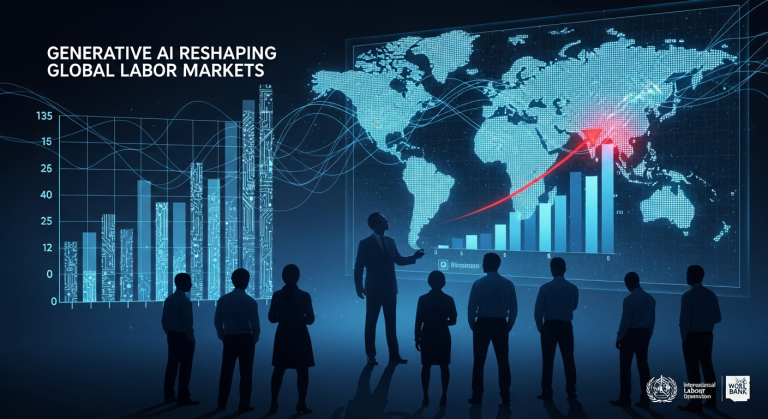
The scale of this transition is staggering. AI scientist Ben Goertzel argues that current large language models (LLMs) have the potential to take over 95% of human jobs, a figure already being discussed for specific fields like procurement. Broadening the scope, Goldman Sachs estimates generative AI exposes roughly 300 million jobs globally to automation, potentially displacing 6-7% of the U.S. workforce within a decade. This isn’t just a story of elimination, however. The World Economic Forum offers a more nuanced forecast: while 92 million roles could vanish by 2030, a staggering 170 million new ones are expected to emerge. The data points not to an end of work, but to a massive, unprecedented restructuring of the entire job market.
The Paradox of Productivity and Intensification
Phenomenal productivity gains are the most visible outcome of AI adoption. An MIT study, for instance, found that highly skilled workers using generative AI boosted their performance by nearly 40%. Vanguard’s research echoes this, projecting time savings around 43% for most occupations. But this surge in efficiency creates a paradox. It does not lead to a more relaxed workplace. Instead, as AI automates rote tasks, human employees are pushed toward higher-stakes strategic challenges, a phenomenon known as work intensification. One study highlights the shift: post-AI implementation, employee communication time more than doubled as deep, focused work time evaporated. The human role is evolving from a task ‘performer’ to a digital labor ‘coordinator’.
The Frontline Casualties: Entry-Level Roles at Risk
Early-career professionals are on the front lines of this disruption. In just two years, the demand for ‘AI fluency’ has skyrocketed sevenfold, eclipsing every other skill. At the same time, the automation of tasks traditionally handled by new graduates is causing the junior talent market to shrink. The numbers from Goldman Sachs are stark: between late 2022 and mid-2025, employment for workers aged 22-25 in AI-exposed roles fell by 16%. Young software developers felt this acutely, with their numbers dropping nearly 20% in that period. The message from corporations is clear: the need to hire new entrants for foundational work is rapidly diminishing.
The New Burden: Ethics and Human Oversight
This transition to supervising vast AI teams introduces a critical new burden: accountability. When an AI agent commits a costly error, where does the buck stop? With the programmer, the corporation, or the human manager overseeing the system? The question is no longer academic. Establishing clear ethical frameworks for fairness, transparency, and accountability has become an urgent corporate priority. A ‘human-in-the-loop’ system, which allows people to understand and override AI decisions, is the only viable path to ensuring ultimate responsibility remains exactly where it should: with humans.
Actionable Conclusion: Shift from Performer to Supervisor
In this new era, there is no time to fear replacement by AI. The only imperative is adaptation. Competitive advantage will now be defined not by how well an individual performs a task, but by how effectively they direct a team of AI agents. Execution-based skills like coding and data entry are losing their premium, supplanted by the need for strategic oversight, critical thinking, and ethical judgment. The future belongs not to those who can outperform AI, but to those who can work better *with* AI. Individuals and organizations mastering this human-plus-AI model first won’t just lead; they will gain an insurmountable edge.
References & Sources